
Romans part 6, “A True Horror Story”
Romans part 5 2:17-3:8
Here is part 5 in the Series: “What Do You Say About God?”
Romans part 4 2:1-16
Here is part 4 of Romans, “You Aren’t as Good as You Think”
Romans part 3 2:1-16
Here is part 3 of my Romans Series, “The Downward Spiral of Sin”
Romans part 2 1:8-17
Here is part 2 of my Romans Series, “The Mission of the Gospel”
Romans part 1 1:1-7
Here is the first part in my series on Romans, “Hello Rome!”
Why you should read “Why Four Gospels?”
I just finished, and thoroughly enjoyed David Black’s Why Four Gospels? The Historical Origins of the Gospels. This is the second edition (the first was published in 2001). Dr. Black alerts the reader in the preface to the first edition that this book is not written for biblical scholars. He seeks to “renew, restore, and strengthen faith in the truth of the Gospels.” As a pastor, this appeals to me. Dr. Black deals with technical information in an easy-to-follow format in this work. I am far from a biblical scholar and Black’s presentation of the material is straightforward and flows well.
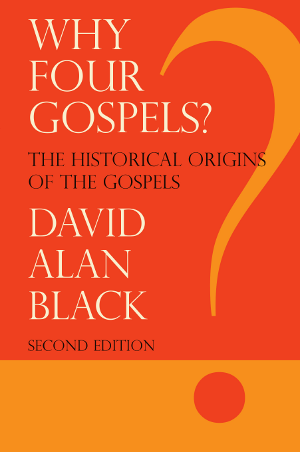
In the first section of the book, Black lays out his hypothesis, the Fourfold-Gospel Hypothesis. He proposes a Matthew, Luke, Mark, John ordering of the Gospels. The basis for this hypothesis is two-fold. First, a chronological look at the spread and needs of the first century church lends itself to this ordering. Second, evidence from the Church Fathers also supports this ordering of the Gospels. The second section of the book gives the evidences from the Church Fathers. He has gone back and translated the writings from the Fathers for this section. Black then evaluates the strength of the Markan Priority position. This is the popular one today in evangelical circles. He argues against this position based on the evidence from the Fathers as well as a logical look at the historical events from the first century. The third section of the book expands on the theory of the composition of the Gospels.
I highly recommend this work for any pastor or person seeking to better understand why we have 4 Gospels and how they came about. I do so for five reasons. First, this is a brief enough treatment to argue for his position and tickle ones interest on the subject (he includes a 20 page bibliography in this 99 page book). Second, he puts forward his hypothesis, examines the evidence, and then expands upon his hypothesis. This makes his argumentation flow well. This issue is somewhat new to me, so his format was very helpful to me. Third, as a pastor and teacher I highly value the context in which the books of Scripture were written. This book helps to clarify the context in my own mind. I can see much benefit in my preaching and teaching ministry through understanding the context of the writing of each Gospel. Fourth, in preaching and teaching, this book helps to harmonize the Gospel narratives. Often in studying Scripture, we struggle with the variations in the Synoptics. And fifth, this book is helpful in providing material and argumentation to refute those in our day who would throw out the reliability of the Gospels themselves. Black’s reliance on the Church Fathers is a great help here. Modern critics almost neglect the Fathers altogether. It is form of what C.S. Lewis called “chronological snobbery”. Black addresses the issue of modern critics’ tendency to doubt the scholarship of the Church Fathers.
Black does a wonderful job introducing this subject to the reader. For me, he has fulfilled his purposes. The book was easy for me to follow as one who is not a Biblical Scholar, and he has strengthened my faith in the Gospels.
Why 4 Gospels?
I just received a copy of David Black’s Why Four Gospels? This is the second edition of his work from 2001. I am looking forward to reading it today and writing a review on my blog.
Visitation Ministry
I was asked today to put together some Scriptures that talk about the need for the church to be involved in a visitation program, especially with regards to shut-ins. This is the group of folks who are unable to attend church services regularly due to prolonged illness, etc. After putting this together, I decided to pot it here as well.
In the New Testament, there are 2 types of visitation ministries. The first is to unbelievers and the second is to believers.
1. Ministry of visiting unbelievers:
In the Gospels, Jesus often ministered to the sick and to those with various needs. He did this to demonstrate His Deity and authority. It was to show them (and us) that He is in fact the Son of God who came to take away the sins of the world. This ministry was done to show who Jesus was. He also sent His disciples out in Matthew 10:5-42. He instructs them about going out to share the Message of God’s Kingdom. This was an evangelistic mission. This was a mission that would bring difficulty and hardship to their very own lives.
In the book of Acts, we see Paul and others undertaking numerous journeys to share the gospel of Jesus Christ to a world full of unbelievers. It was a dangerous task for which many lost their lives. Their primary reason to go to unbelievers was to lead them to a saving knowledge of Jesus Christ
2. Ministry of visiting believers:
In the New Testament there is much discussion about the Church ministering to fellow believers in this way. This is what we usually think of regarding what we call “Visitation.” There is not a description of this type of visiting to unbelievers, only ministry like this to believers. For the ministry to unbelievers, the New Testament church was very evangelistic and intentional about sharing the Gospel message in hopes of leading people to faith in Christ.
There are several places that we see believers sharing their possessions with fellow believers. This was done primarily because they had to rely on each other, particularly when faced with persecution. They often sold possessions and used the proceeds to meet the needs of fellow believers. This is seen in Acts 4:32-37, in 2 Corinthians 8:12-15, and in Galatians 6:10. We are told to be hospitable in this ministry in Romans 12:13. Paul gives Timothy some instruction regarding our response to older men and women in 1 Timothy 5:1-2. There is a lengthy, detailed discussion about ministering to widows in 1 Timothy 5:2-16. This passage shows us the responsibility we as a church have to minister to the widows in our church. Within that, there are “guidelines” that Paul gives.
Concerning ministry to shut-ins, the passage that comes to mind is Hebrews 10:24-25. Here, we are told that the church members have a responsibility to encourage one another. He says this is why we should not “forsake the assembling of ourselves together.” In other words he says, “don’t skip church due to laziness and irresponsibility.” One of the primary reasons we gather together to worship the Lord is so we can all encourage one another. Those who are shut-in due to medical and other conditions are unable to do this. We who are healthy have a tremendous opportunity to go to them and give them encouragement. They also have the opportunity to encourage us and spend time with fellow believers since they are unable to do it on a regular basis. So, this passage in Hebrews that focuses on church attendance, gives us more reason to visit believers who are unable to attend church.
Matthea’s Testimony
Thank you for your prayers for Matthea and I in these past 2 weeks. God has shown His strength to us in so many ways. This past Sunday, Matthea shared about God’s faithfulness during our morning worship service. The Lord used it to minister to many people! I am posting the audio of what we shared. After she spoke, I read Matthew 6:25-34 and then Jennifer Evans sang “His Eye is On the Sparrow”. All of this is included in this 10 minute clip. After the song, Anne Graham Lotz spoke from John 17:1-5 about what it means to have a relationship with God. It was a powerful service!!
Here are 2 pictures from this Sunday. It was also our annual UNC Lady Tarheel Family Day. Their coach, Sylvia Hatchell, has been a faithful member of our church for over 20 years.


 A Pastor's Thoughts