Studying the Scriptures, Part 2

Sorry it has been 2 weeks since part 1 of this series.  Here is part 2 of my studying the Scriptures and teaching the Scriptures series.

2.  Don’t be afraid of the questions.

Christians are often too cautious to ask the hard questions.  Not only questions about God and Jesus in general, but also specific questions about the text.  We shouldn’t be.  the Bible can stand on its’ own without any trouble.  The Lord has preserved His Word for a few millenia, our questions won’t make a difference.  If you are a follower of Christ He has given you the Holy Spirit.  He aides us in understanding the Word of God.  We cannot begin to truly understand the Scriptures without the Holy Spirit.  Therefore, you must be a believer to truly understand the Scriptures.  This is what Paul says in 1 Cor. :12-16.  When studying the Scriptures, don’t be afraid to ask “what does this mean?”  Don’t be afraid to wrestle with the text.  Often it means just what it says.  We like to pick apart words, phrases, and letters.  The truth is that it often means just what it plainly says!

When teaching the Scriptures, anticipate the questions that may be raised in the minds of the audience members.  This is good teaching!  Perhaps even ask the question and answer it in your presentation!  But above all else, don’t be afraid of the questions that may be asked.  Know what you are teaching, know what you believe, trust the Holy Spirit, and teach!

Politics?

Matthea and I spent some time with some dear friends yesterday and the topic of politics came up, briefly.  We discussed the issue some on the way home.  We are concerned about things in our country, we have been for several years (not just several months like some of our friends).  Isn’t it refreshing that our citizenship is in Heaven.  Earth is not our home, the United States isn’t our home, North Carolina isn’t our home, and Durham isn’t our home.  When Matthea and I gave our lives to Jesus (age 20 for me, 19 for her) we became citizens of a Kingdom far bigger and far greater than the United States.  In fact, we are now citizens of a Kingdom that has been around forever and will be around forever!  That’s more than I can say for our current country of residence!  I love the freedoms we enjoy in our country, but the truth is we are aliens and foreigners here.

I have had the chance to visit 1 other country in my life (2 if you count Canada, but not much cultural difference).  I spent nearly 3 weeks in Ethiopia last Fall.  I was not a citizen of the U.S. while there.  I was not a citizen of Ethiopia while there.  I was and still am a citizen of Heaven.  I am simply still on the earth as His ambassador.  I am to represent my King and His interests while here.  When I put my life into that perspective, our current political back and forth in the United States fades in importance. If we ever lose freedoms here, it won’t matter.  There are places in the world without our “religious freedoms”, and His Kingdom is doing just fine there!  If you are in His Kingdom, our earthly place of residence simply becomes secondary!

Studying Scripture part 1

As promised, here is the first installment of my series on Studying and Teaching the Scriptures.  This is not an exhaustive list.  Many others, far more qualified than I, have put together their thoughts on the subject.  I simply want to pass along some thoughts of mine when it comes to studying and teaching Scripture.  While flying a few months back, I pulled out my notebook and began to jot down thoughts related to this issue.  They fall under 5 main categories.  Hopefully, they will serve as these 5 posts.  So, here goes:

1.  Have an understanding of the conceptual nature of Scripture

Here is what I mean.  God has given us His Scriptures through human authors.  2 Tim. 3:16 tells us that all Scripture is God-breathed.  From that starting point we must understand that each “book” of the Bible was written by an author with a certain audience in mind.  All of Scripture has application for us, otherwise God wouldn’t give it to us.  In order to better understand what we are reading and studying, we must first know something about the original audience.  The Scriptures cannot mean something to us that they did not mean to the original audience.  I am speaking in terms of application.  An example would be the admonition against gossip.  We would say today to be mindful of those quick little phone conversations that can dip into the arena of gossip.  Christians in the first century knew nothing of a telephone, but there is application today about our telephone conversations when we discuss the broader teaching on gossip.

The Scriptures are conceptual in that God wants us to understand the concepts that are being conveyed.  There are Universal truths in the Scripture.  It was true when it was written and it is still true today.  God has never changed His truth.  Our society and culture has changed, but God’s Word has not changed.  In studying Scripture we must derive the principles being taught and then apply them to our lives today.  What was sin in the first century is still sin today.  Too often we focus on the outward thing when it comes to identifying sin, but the realty is that sin is more often in our hearts and minds than in our actions (see Matthew 6 and the Sermon on the Mount for more on this)

There are some helpful tools in understanding the broader teaching of Scripture.  Survey studies, Book Introductions, and individual book studies help a great deal.  When we pick up our Bibles and begin reading at some random point, we are much less likely to understand the text within its’ context.  Study the Bible by books.  This is one reason why I preach through books of the Bible in my sermons on Sundays.  In fact, this past Sunday we began a study through Ephesians.  Lord willing, we will be here until March ’10.

not a job

When I was a Pastoral Ministry Major at Liberty University, I remember having a professor talk about leaving one field of ministry and going to another.  His statement was, “when you leave a church, leave it.”  He said to cut ties and move on to the next place.

I have always been troubled by this philosophy.  First, it is not what we see in the New Testament.  Paul didn’t leave a place and never return, or think about them, etc.  Second, ministry is life.  Ministry is relationships.  Twice in my life the Lord has led our family to a new area of vocational ministry.  Neither time did we “cut every tie.”  We have avoided being involved in the search for leadership, but we have not forgotten about the people.  Ministry is people.  I have never viewed being a Pastor as a “job.”

Today we got to visit with some members of our former church.  We spent some time with them.  We had dinner with some of them.  It was a great day.  In fact, our kids spent the night with their adopted grandparents last night.  Wherever you serve the Lord in ministry, it is never a job.  It is life, relationships, and people!

Undermining the Authority of Scripture

I was visiting the campus of Southeastern Seminary today and I stopped in for chapel.  It was their convocation service to begin the new semester.  Dr. David Nelson, VP for Academic Administration, brought a great message about the authority of Scripture.  His title was intriguing, “How to undermine the authority of Scripture”.  You can access the message here.  He talked about how we evangelicals stand on the authority of Scripture, but too often we are not faithful to the text in our preaching, teaching, and living.  Dr. Nelson shares my conviction of being an “equal-opportunity-offender.”  Every listener will be offended at some point in this message!

I was planning to start a series of blogs on studying and teaching the Scriptures.  After today’s sermon, I’ll wait another day or two before this blog series 🙂

A Proper Perspective

I struggle as a believer with having the correct eternal perspective in life.  This has been on my mind lately since hearing news of a dear friend who was diagnosed with Cancer recently.  I encourage you to read about it, pray for her, and be encouraged by her articles on cancer and suffering here, here, here, and here.  Our family has been praying often for BeckyLynn, I ask you to do the same.  Her surgery is this Friday the 21st.

What has been on my mind is the idea of priorities and perspectives.  I winder if I were in her place, hearing the news and diagnosis from the doctors, would I still be serving the King with all I have?  Would my priorities shift to making the most of the remainder of my time on earth?  In the flesh, perhaps I would create a Bucket List.  As a follower of the King I know that my priority should be to use every available moment to further His Kingdom while I still can.  Once in Heaven, I can do nothing to further His Kingdom.  I can do nothing to fulfill the Great Commission.  While on earth, I can do these things.  If I got the news that I was terminally ill, I should view that as a warning call to do all the Kingdom Building that I can.  My prayer is that I would.  My earnest hope is that I live every day as if I were leaving earth soon.  After all, that’s how the New Testament tells me to live.  Lord, grant me the proper perspective in my life!

Life Lesson from a Toshiba Copier

A few days ago I was in a hurry to print something from my computer.  We recently leased a new Toshiba copier for our office that also serves as our shared printer.  I pulled up my document on my laptop and pressed “print”.  I then walked over to the machine and waited and waited and waited.  It was making noises, but no printout.  The screen had a message however.  It said, “Performing self-check, please wait.”  I thought to myself this was a good thing for a copier to do at the start of the day before it got busy.  I wondered how often I begin the day with a “self-check”?  Too many times I am ready to hit the ground running and I don’t get myself fully prepared for the day ahead.

So while waiting for the copier (btw a watched copier never prints) I learned a good lesson and hope you do too.

Should We Do Everything?

I understand that many decades ago Baptists and other religious organizations started medical clinics and hospitals in order to better provide humane, loving care to people.  But, do we have to do everything?  In a day when many baptist churches are removing the word “baptist” from their names, it was surprising to find the word baptist in a name.  While driving to Fernandina Beach on Amelia Island (near Jacksonville, FL) I spotted a sign for this new practice, Baptist Obstetricians.  I am not opposed to what they are trying to accomplish, my family has benefited greatly from this type of medical care (just ask our three children).  I am concerned with we as Baptists doing anything and everything instead of doing the main thing we are called to do.  We are called to make disciples.  Clear and precise.  This is done by bringing people to a knowledge of Jesus and then teaching them to follow Him.  I am not sure how this can happen in an OBGYN doctor’s offic.?

I am concerned about the situation over at the International Mission Board of the Southern Baptist Convention.  They are seeing a huge budget shortfall in this past year and will not be able to support the missionaries who are preparing to go.  I am thankful that our church and may others are stepping to the plate to have a special offering.  But in North Carolina the state convention keeps 68% of “missions giving” within our state.  There are worthwhile programs and ministries, but there are over 4000 church scattered (stacked on top of each other) through our state.  We do a lot of things.  Even some medical care.  My prayer is that we bapists get back to doing the things we are called to do.  Other things may be an avenue to accomplish discipleship, but the cannot be an end in themselves.  I pray this begins with me, with our church, our state, our denomination, and every follower of Jesus!

Pray

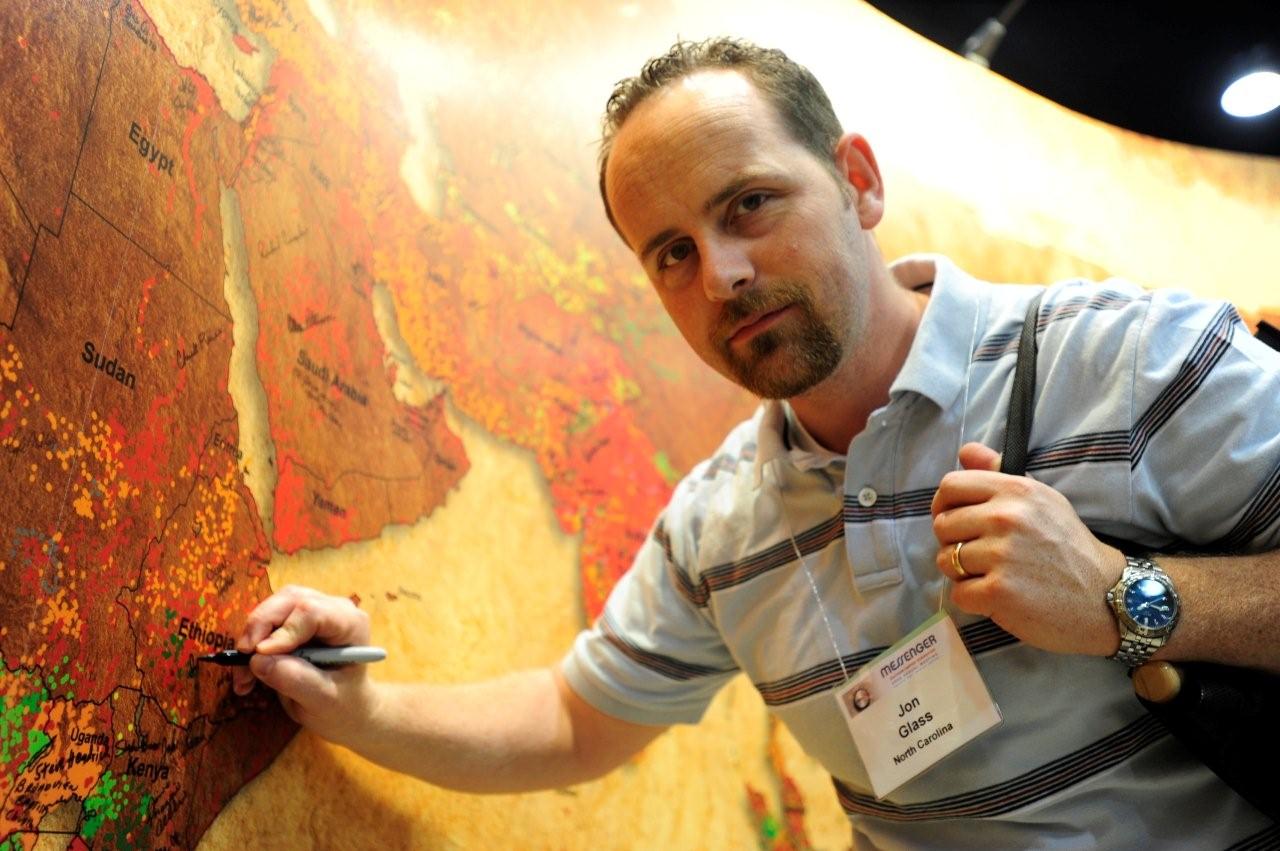
I just received a pic via email from the IMB (International Mission Board).  At the SBC Annual Meeting, the IMB Booth had a large map and asked people to sign an area and pray for the people in that place.  I signed in southern Ethiopia.  I don’t know if that was “fair” or not, since I already pray for the people there!

_LMG8833 (3)

The Jesus Paradigm

I finished reading The Jesus Paradigm by David Alan Black.  I have had several conversations with Brother Dave that gave me an opportunity to hear his heart and expect what I found in this book.  It is not for the faint of heart.  The writer challenges all of us who follow Jesus to truly follow Jesus’ example.  He gives many examples of how the American Church has moved so far away from the New Testament church.  This book calls the reader back to a simple faith, a life of simple obedience to the calling of Christ.  As the author points out, we have moved so far from this pattern in our lives and our churches, that many ideas seem foreign to us.

Dave Black spends several chapters showing the example of the Anabaptists, the 16th century Radical Reformers.  He does a great job explaining their communal, biblical lifestyle.  We would all do well to learn from the Anabaptists, as Black rightly points out.  He gives emphasis to concepts that we have largely lost today.  The biblical pattern of “every member ministry” is found throughout this work.  It is a good reminder to us all that we each have a responsibility to follow the Lord and be involved in His Kingdom work.  Throughout the book, Black offers examples of how his family has changed their lifestyle to be more committed to following Christ.  This is not done in a self-righteous way, but to give concrete examples of ways every believer can more closely follow Christ.  Dr. Black is a respected scholar, but the things he shares in this work did not come from time in the library, but rather from time spent with the neglected, poor, humble, and forgotten…the same types that Jesus spent His time with.

I would encourage any follower of Jesus to read this book.  It will challenge your thinking.  May God use it to bring His church closer to Himself!